A Path to Competition and Self-Defense Mastery
Master Your Reaction Time
Test your reflexes and compare your reaction time with fighters across different disciplines.
Select Your Discipline
Strikers
Definition: Fighters who primarily use punches and hand techniques for combat.
Examples: Boxing, Panantukan, Wing Chun, etc.
Average Reaction Times:
- Novice/Beginner: 300-400ms
- Amateur/Semi-Pro: 220-300ms
- Professional: 150-220ms
Kickboxers
Definition: Fighters who use a combination of punches and kicks in their fighting style.
Examples: Muay Thai, Savate, Sikaran, etc.
Average Reaction Times:
- Novice/Beginner: 320-420ms
- Amateur/Semi-Pro: 240-320ms
- Professional: 180-240ms
Grapplers
Definition: Fighters who focus on taking opponents to the ground and using submission techniques.
Examples: Brazilian Jiu-Jitsu, Judo, Wrestling, San Shou, etc.
Average Reaction Times:
- Novice/Beginner: 280-380ms
- Amateur/Semi-Pro: 200-280ms
- Professional: 140-200ms
Mixed-Martial Artists
Definition: Fighters who combine various martial arts techniques from different disciplines.
Examples: MMA, Jeet Kune Do, Krav Maga, etc.
Average Reaction Times:
- Novice/Beginner: 290-390ms
- Amateur/Semi-Pro: 210-290ms
- Professional: 150-210ms
Weapons-Based Fighters
Definition: Practitioners who specialize in combat with various weapons.
Examples: Arnis, Fencing, Iaido, Practical Shooting, etc.
Average Reaction Times:
- Novice/Beginner: 310-410ms
- Amateur/Semi-Pro: 230-310ms
- Professional: 170-230ms
Your Results
Average Reaction Time: 0ms
Best Reaction Time: 0ms
How You Compare
| Skill Level | Reaction Time Range | Your Standing |
|---|
Master Your Moves Mindmap Flowchart Tool
Here’s a straightforward guide to using the mindmap tool for organizing your martial arts fight plans, with examples for Brazilian Jiu-Jitsu (BJJ), Jeet Kune Do, Muay Thai, or any martial art you practice.
This tool helps you visually organize techniques and concepts, making your fight plan clear and easy to follow.
1. Add Nodes
Click the “Add Node” button to create a new node.
Example: For BJJ, add nodes like “Guard,” “Mount,” “Sweeps,” or “Submissions.”
The node will appear in the center of the canvas, ready for you to type your text.
Click directly on the node’s text to edit it. You can type multiple lines and format your notes.
2. Move Nodes
Click and drag a node to reposition it anywhere on the canvas.
On mobile or tablet, tap and hold a node, then drag it to the desired location.
3. Connect Nodes
Click the “Connect Nodes” button to enter connection mode.
Click one node, then click another to draw a connecting arrow.
Example: Connect “Guard” to “Sweeps” to show progression or relationship.
Click the “Connect Nodes” button again to exit connection mode.
4. Delete Nodes
Select a node by clicking or tapping it (it will highlight with a yellow border).
Click the “Delete Node” button to remove the selected node and its connections.
Alternatively, select the node and press the Delete or Backspace key on your keyboard.
This prevents accidental deletion while typing inside a node.
5. Editing Text
Click or tap inside a node to edit the text.
Use backspace and delete keys normally to remove characters or words without deleting the entire node.
Press Escape or tap outside the node to finish editing.
6. Export Your Mindmap
Use “Export PNG” to save your mindmap as an image.
Use “Export PDF” to save a printable PDF version, including your name and title entered at the top.
Example Workflow for BJJ Training:
Add nodes: “Guard,” “Passing,” “Sweeps,” “Submissions.”
Connect “Guard” → “Sweeps” → “Passing” → “Submissions” to show flow.
Add notes inside each node, e.g., under “Sweeps,” write “Hip bump sweep, scissor sweep.”
Move nodes around to organize visually.
Export your mindmap to review or share with your coach.
Use the MYM Method to Fight Better In…
-
![]()
Judo
Judoka learn how to craft strategies that consider their unique skills and tournament regulations, enabling effective analysis of their throwing techniques, fostering confidence to execute decisive moves, and achieving optimal focus in high-stakes situations.
-
![]()
Jeet Kune Do
MYM’s customizable fight plans empower Jeet Kune Do practitioners to adapt their strategies for personal strengths and self-defense laws, while fight analysis enhances their tactical skills, boosts their confidence in critical moments, and prepares them to perform fluidly and powerfully.
-
![]()
Wrestling
Using MYM tools and methods, wrestlers can craft fight plans that leverage their unique skills while adhering to competition regulations, analyze their grappling techniques for improvement, develop confidence in challenging scenarios, and achieve peak performance during matches.
-
![]()
Boxing
By designing fight plans based on individual strengths and the rules of engagement, Boxers can effectively analyze their fighting styles, build confidence to face opponents, and enter the ring in the performance zone for strong, decisive action.
-
![]()
Muay Thai
With personalized strategies that adapt to tournament rules and state laws, Muay Thai practitioners can analyze their striking techniques to improve performance, cultivate confidence for high-pressure situations, and consistently fight with power and precision in the ring.
-
![]()
Karate
Customizable fight plans allow Karatekas to refine their techniques based on personal strengths, while fight analysis helps improve kata and sparring, boosting confidence to face opponents and ensuring peak performance during competitions.
-
![]()
Brazilian Jiu Jitsu
By leveraging customizable fight plans tailored to individual strengths and weaknesses, BJJ students can enhance their sparring techniques, build confidence to tackle challenges on the mat, and enter the performance zone primed for fluid execution in grappling scenarios.
-
![]()
And More!
From Aikido to Zulu Stick Fighting, the MYM Method will help you be a more cool, calm, and confident fighter in the ring, the cage, the mat, or the streets.


Here’s how you’ll improve with the MYM Method and MYM tools.

• Customizable Fight Plans: Design and modify strategies based on:
Personal strengths and weaknesses
Tournament rules (for athletes)
State laws (for US self-defense)
• Fight Analysis: Evaluate and improve your sparring techniques to prepare for a fight in the ring, the mat, the cage, or the streets
• Confidence Building: Overcome fear in critical moments to step up to any challenge you face
• Performance Zone: Get yourself primed to perform in the zone and fight confidently, smoothly and powerfully
Start FIGHTing better today.

MYM Tools: Fight Better
(Fillable PDFs)
-
FREE
BJJ Skills Checklist (2 pgs)
Boxing Skills Checklist (2 pgs)
Karate Skills Checklist (2 pgs)
MMA Skills Checklist (5 pgs)
Muay Thai Skills Checklist (3 pgs)
Wrestling Skills Checklist (2 pgs)
And MORE to come! Subscribe and be the first to know!
-
FREE
1 pg.
-
Master the game with our Tournament Rules Breakdown. These concise charts highlight the crucial rules of major tournaments that coaches and fighters must know to ensure they're always one step ahead. Save time, stay informed, and adapt your strategy for victory. Get the competitive edge now.
IBJJF Tournament Rules (11 pgs)
And MORE to come! Subscribe and be the first to know!
Get them HERE


The MYM Training Notebook
-
What do George St. Pierre, Tom Brady, Muhammad Ali, Serena Williams, Conor McGregor, Michael Phelps, Anderson Silva, Floyd Mayweather Jr., and Bruce Lee have in common?
They ALL used training journals to become the best in their discipline or sport. The MYM Training Notebook is designed specifically for martial artists who want to excel.
Book Details:
Smyth-sewn lay-flat bookbinding
Two (2) ribbon markers (blue and red)
Matte hardcover
Dimensions: 8 x 10
Page count: 108 pages
Pages are 1/2 college-ruled and 1/2 blank for notes, sketches, flow charts, mindmaps, etc.
Built-in MYM shorthand key to make note-taking quicker and easier to read
Stay organized and find what you need quickly with these additional features:
Table of Contents
Demonstration Pages
Index
Additional Notes Section
Events Calendar
Training Schedule
-
FREE Shipping & Handling (U.S. & territories ONLY)
Even though we know you will love your MYM Training Notebook, we offer a 30-day MONEY-BACK REFUND guarantee.
-
9 FREE martial arts books for the nerd and novice in you!
These 9 books cover different arts from karate, boxing, BJJ, Krave Maga, and more!
2 FREE MYM Samurai Warrior bookmarks.
-
Studies on skills development & training effectiveness show that writing is key to LEARNING and PERFORMING better¹ and that it also BOOSTS your brain power,² which helps retain more.

What People Are Saying about how the MYM Training Notebook helps them FIGHT
“I want to apply for a wrestling scholarship next year so I need to continuously score points against elite competition. With the MYM Notebook, I can measure my progress.”
— Brenda J., Wrestling
“Ever since I started boxing, I wrote down combos, drills… stuff that worked for me. Whenever I need to try something people haven’t seen in sparring, I just look at my old notes.”
— Jeff T., Boxing
“I want to be a pro MMA fighter one day and I use it to collect everything I do from the different gyms I go to.”
— Jose B., MMA (BJJ, Boxing, Muay Thai)
“I’m into training for reality-based scenarios and I like that there are pages I can map out my ideas or do flow charts in. Helps me strategize and come up with drills.”
— David R., Jeet Kune Do
The MYM 4-Ink Tactical Pen
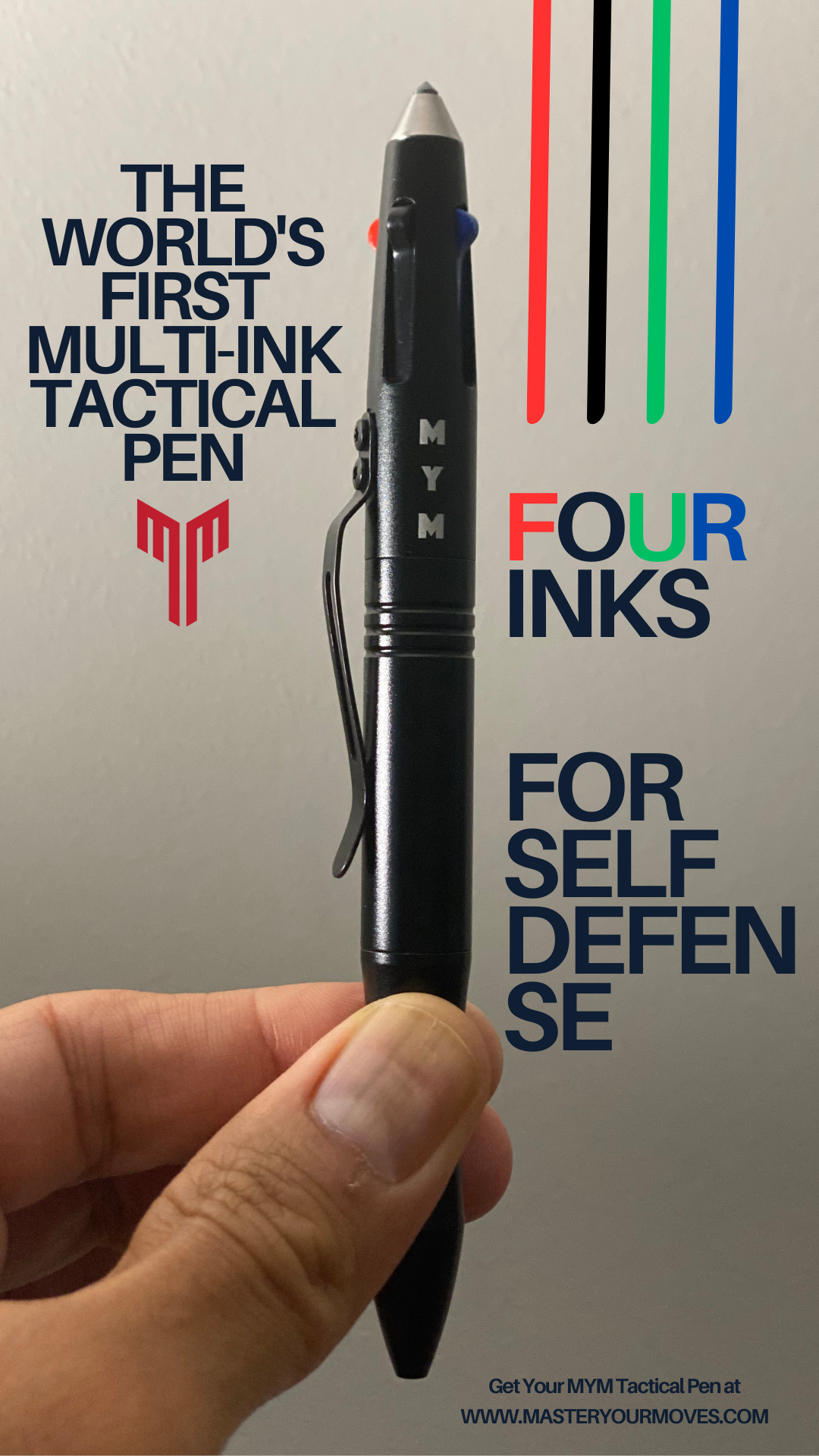
The World’s First Multi-Ink Tactical Pen
-
Introducing the pen that will help you learn AND protect you in a fight… the MYM 4-Ink Tactical Pen, crafted from durable aircraft-grade anodized aluminum.
With its grooved design for enhanced grip, this pen feels secure in your hand, ready for any situation, whether you're taking notes or taking names.
In a sleek black matte color with a discreet black finish pocket clip, it exudes both style and functionality.
But what sets it apart is its versatility - THE WORLD’S FIRST TACTICAL PEN WITH 4 INKS: BLACK, BLUE, RED, GREEN.
Prepare for any task or emergency with ease, as this pen doubles as a powerful defense and restraining device or emergency tool.
Master your moves with the MYM 4-ink tactical pen.
-
Weight: 0.9 oz
Writing width: 1.0mm
Dimensions: 5.9 x 0.5 inches
Matte black anodized aircraft-grade aluminum construction with black finish pocket clip. The same grade of aluminum used in aircraft is CNC machined for maximum strength-to-weight ratio.
Inks: Black / Blue / Red / Green
One end is pointy for self-defense or emergencies, while the other end can be used as a self-defense or control device.
Brand Logo: MYM (Master Your Moves)
-
FREE Shipping & Handling (U.S. & territories ONLY)
Even though we know you will love your MYM Tactical Pen once you get it, we offer a 30-day MONEY-BACK REFUND guarantee.